Pairing oversized tile slabs with organic and industrial materials might seem counterintuitive. After all, one of the main reasons people choose these surfaces is their clean, uninterrupted look. Cover a room entirely in hard, flat material, however, and something vital is lost. The space needs texture, warmth, and contrast to feel livable. Here is how wood, metal, and natural elements can transform a tile-heavy interior.
What Makes Oversized Tile So Popular
Compact square tiles are increasingly overshadowed by slabs that span two feet or more. Walk into any tile shop today and you will notice this shift on every shelf. The appeal boils down to simplicity. Fewer grout joints create a visual calm that smaller pieces cannot achieve. Cleaning becomes easier too, since grout lines trap grime and resist scrubbing.
These expansive surfaces have a spatial trick up their sleeve. Large format tiles minimize visual interruptions, helping rooms feel much larger than they are. The floor reads as one continuous plane. Finishes have diversified considerably as well—polished porcelain, raw concrete aesthetics, and stone-look surfaces are all widely available. Modern manufacturing allows ceramic to replicate marble, travertine, and limestone with remarkable precision.
There is a catch, though. When every surface in a room is hard and visually uniform, the result feels sterile. Think of an empty gallery—beautiful, yes, but not exactly inviting. That uniform perfection demands counterpoint: materials that introduce irregularity and tactile depth.
The Warmth of Wood
Few materials soften hard tile surfaces as effectively as timber. Wood introduces grain, warmth, and a sense of age that manufactured surfaces simply cannot replicate. Pairing the two creates a dialogue between the natural and the engineered. That tension is what makes a room feel considered rather than simply finished.
Consider a kitchen scenario. Large format tiles cover the floor from wall to wall. Solid timber cabinetry—perhaps oak or ash—rises along the vertical surfaces. The grain draws the eye upward, countering the broad horizontal sweep of the floor below.
Color pairing deserves careful attention. A cool-toned slate-look floor pairs naturally with warm walnut or honey-toned cherry. The contrast reads as intentional and balanced. For darker installations, lighter woods such as maple or birch prevent the palette from feeling oppressive.
Timber can serve a structural role as well. A wooden transition strip between a tiled room and an adjoining space creates a more graceful threshold than a metal alternative. On walls, timber cladding adjacent to ceramic surfaces evokes a spa-like atmosphere. Wood also dampens sound, which matters in rooms dominated by hard, reflective surfaces.
Metal as a Design Element
Metal provides definition. It introduces crisp edges and visual punctuation that help organize a space dominated by large, uninterrupted planes. Think of it as the frame around a painting—subtle but essential.
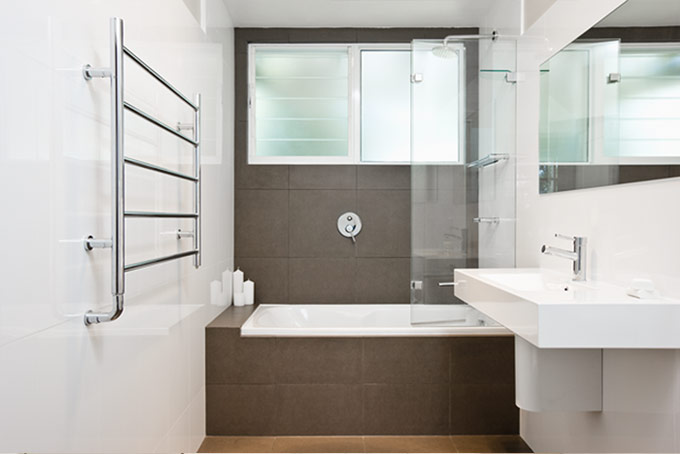
Fixtures offer the most natural entry point. A shower clad in porcelain becomes a showcase for a brushed brass rain head or matte black faucet. The metal catches light and provides a focal point. Nickel, chrome, and black finishes each work differently, but all create moments of contrast against broad ceramic fields.
Trim pieces serve a similar function. A quality tile shop will carry a range of metal profiles designed specifically for finishing tile edges. These strips create a sharp, contemporary line where tile meets painted drywall. Matte black finishes against white or pale grey surfaces produce a particularly graphic quality. This kind of detail elevates a room from competent to refined.
Architectural metal deserves consideration too. A steel stair stringer set against a tiled floor creates visual drama. Dark-framed windows—whether bronze or black steel—frame outdoor views while harmonizing with interior surfaces. The guiding principle is restraint. A few deliberate metal elements carry more impact than a room saturated with metallic finishes.
Natural Textures and Soft Furnishings
Regardless of how convincing their surface patterns may be, manufactured slabs are inherently uniform. To counteract that precision, you need materials that embrace imperfection. Woven fibers, unglazed ceramics, living plants, and leather all fill this role beautifully.
A large area rug in jute or sisal is perhaps the simplest intervention. The coarse weave contrasts with the smooth floor underneath. It adds cushioning underfoot and absorbs the echo that hard surfaces produce. Size matters—a rug that is too small reads as an afterthought. Aim for dimensions that extend beneath the front legs of your seating.
Soft textiles along walls have a similar effect. A linen curtain beside a tiled surface introduces gentle folds and filtered light. A wool throw draped over a chair near ceramic flooring creates an accessible, lived-in quality. These small additions shift the mood of a room considerably.
Large format tiles create the ideal stage for living greenery. The contrast between organic plant forms and geometric surface lines is visually striking. A tall potted fiddle leaf fig or a cluster of hanging ferns both work well. Smaller natural objects—a woven basket, a carved bowl, a ceramic vessel—add depth without clutter. Leather, whether in a chair or ottoman, introduces a rich tone that develops character over time.
Practical Guidelines for Blending Materials
A few principles help ensure the mix works well in practice.
Always evaluate samples within the actual space. Even the best tile shop showroom has lighting designed to flatter products. Your home has different conditions. Place your chosen slab beside cabinet samples and fixture finishes. Check the relationship under both daylight and artificial light.
Scale the surrounding elements to match. Large format tiles demand furnishings with proportionate visual weight. A small, delicate rug will look dwarfed on an expansive floor. Choose furniture and textiles that hold their own in the room. A substantial sectional or a long dining table reads as appropriately matched.
Maintain a disciplined color scheme. Select two dominant tones and reserve one for accent. If grey tile and warm wood anchor the room, metal becomes the accent layer. Avoid introducing additional bold hues. When too many colors and textures compete, the result feels chaotic rather than curated.
Factor in the room's practical demands. Bathrooms require moisture-resistant materials, so timber selections should be sealed or replaced with engineered alternatives. Living spaces allow for more delicate furnishings since they will not face daily water exposure. Matching material choices to the room's function prevents costly mistakes.
Final Thoughts
Combining expansive tile surfaces with wood, metal, and natural materials is fundamentally about equilibrium. The tile provides durability and a clean visual foundation. The supporting materials introduce the warmth, texture, and character that make a space genuinely comfortable. Neither element works as well in isolation.
Move deliberately through the selection process. Gather samples, test combinations in situ, and observe how different materials interact throughout the day. When the balance is right, the room will feel resolved. You will end up with a modern interior that still manages to feel personal.